Two marketers. Same title. Same salary. Completely different output.
One builds a comprehensive campaign brief in 20 minutes, pressure-tests five competitive angles before lunch, and has a multi-channel performance dashboard that updates itself. The other spends the same week on a single PowerPoint deck. The difference isn't creative brilliance or years of experience—it is a widening divide in AI literacy that is changing the economics of marketing labor.
The gap is not talent, it's leverage
I have watched this divide open up daily over the last three years. The marketers who leaned into generative tools early are moving faster, producing better-tested work, and carrying a scope of work that previously required an entire department. The ones who avoided it, often out of anxiety about creative purity or job relevance, are finding themselves severely exposed.
This divide isn't about using AI as a glorified Google search or a basic copy editor. The real gap lies between "prompt-level" and "system-level" thinkers. Standard prompt-level usage—asking a chatbot to write a social post—offers incremental time savings. System-level integration, however, is where the true competitive divide lives. It is the difference between asking AI to draft an email and using AI to build a semi-autonomous competitor monitoring system that flags price changes and suggests counter-campaigns across five distinct brands.
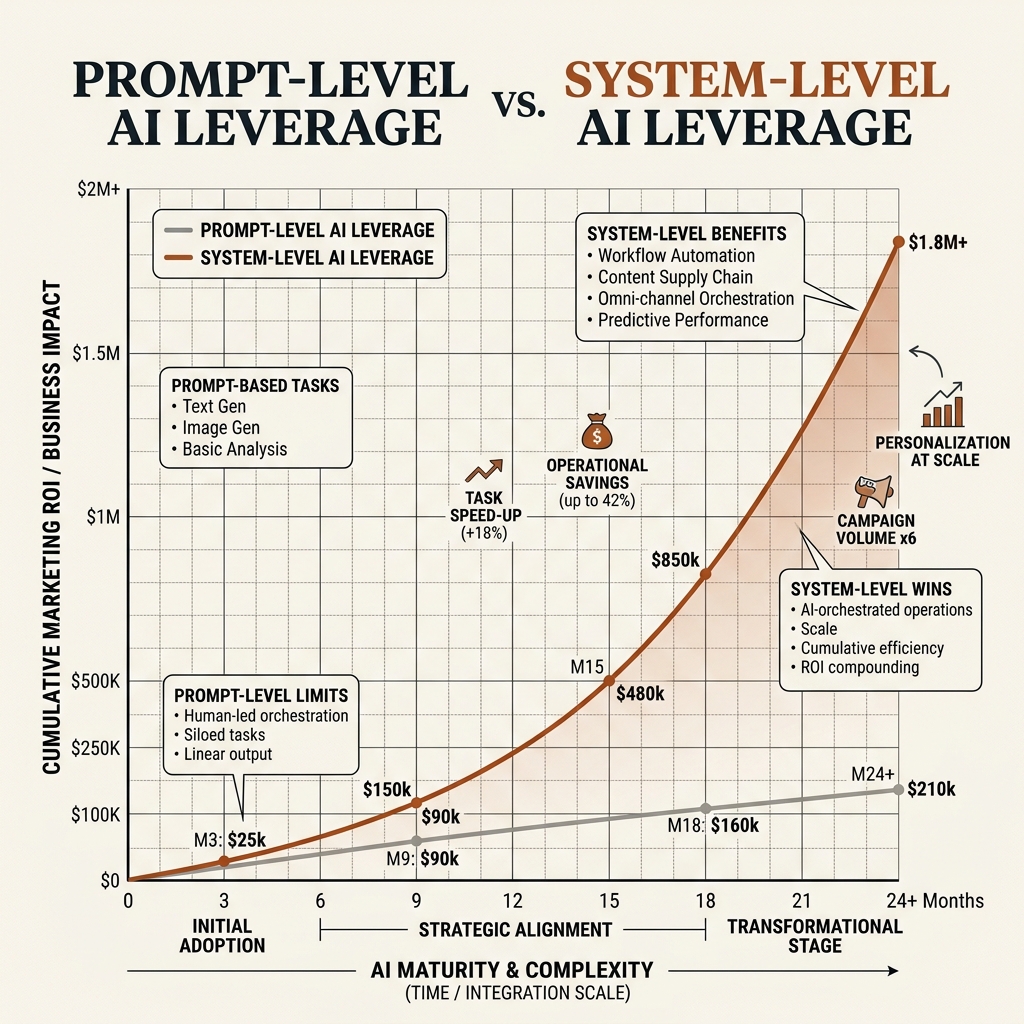
Three areas where the divide is most obvious
If you look closely at marketing execution today, the divide reveals itself across three primary dimensions:
- The Speed of Strategy: Standard marketing processes require days of research, synthesis, and alignment before a strategy document is written. An AI-literate leader uses LLMs as strategic sparring partners, feeding them raw market data, running budget simulations, and identifying positioning flaws at 7:00 AM. They go into stakeholder meetings with their assumptions pre-attacked and refined.
- Creative Variation and Testing: Instead of writing a single set of ad copy and hoping it resonates, system-literate marketers use AI to generate dozens of structured variations tailored to specific customer segments—whether it's targeting budget-conscious retail buyers or premium commercial fitness clients—and launch them simultaneously to let the data decide the winner.
- Technical Independence: In traditional setups, marketing teams are bottlenecked by developer queues. If a landing page needs a custom layout change or a tracking script needs fixing, the marketer waits. Today, those who can use AI to write clean, semantic HTML, CSS, and JavaScript can troubleshoot issues and deploy conversion rate optimizations (CRO) by lunchtime themselves.
The uncomfortable reality for leaders
AI literacy is no longer a differentiator; it is a baseline requirement. A few years ago, demonstrating AI-assisted workflows in a portfolio was impressive. Today, failing to show how you use these tools to drive operational efficiency is a visible gap.
For marketing leaders, this creates a new mandate. You cannot direct a modern marketing function if you do not understand the leverage these tools provide. You cannot budget effectively if you are still paying agency retainers for simple production tasks that a single AI-assisted internal specialist can handle in an afternoon. The divide is not just separating individual contributors; it is separating companies that can move at the speed of software from those stuck in traditional execution cycles.
How to bridge the gap
The good news is that this divide is not structural. It is entirely behavioral. The tools are not highly technical, and you do not need a computer science degree to utilize them. The barrier is mindset.
The fastest way to cross the divide is not to take another high-level certificate course or read vendor brochures. It is to pick a real, manual task on your plate this week—whether it is a competitor audit, an email sequence build, or a landing page layout optimization—and force yourself to build an AI-assisted system to solve it. Once you experience that level of operating leverage, going back to the old way of working is no longer an option.