Every few years, the marketing industry declares its own fundamentals obsolete. Social media supposedly killed advertising, content marketing killed the sales funnel, and now artificial intelligence is supposedly killing everything else. Having integrated AI as deeply into my daily workflow as anyone in the field, I will say it plainly: AI has revolutionized marketing's tools, but it has not changed its physics.
The questions haven't moved
Philip Kotler's core strategic questions determine commercial outcomes today exactly as they did decades ago. Who is your target customer, and what job are they hiring your product or service to perform? Which specific market segments will you dedicate your resources to, and which will you have the discipline to ignore? What unique space do you occupy in the buyer's mind compared to the competition? Is the product fit for purpose, priced accurately, and available where the customer looks?
No large language model or generative tool can make these choices for you. AI can process vast amounts of unstructured data and pressure-test your strategic hypotheses with incredible speed, but it cannot make the hard choices that define a business. Strategy remains an exercise in human judgment, trade-offs, and conviction.
What actually changed: The collapse of execution friction
What AI has actually changed is the cost, speed, and volume of execution. The friction between an idea and its launch has collapsed to near-zero. Market research that once required weeks of analyst hours can now be summarized in minutes. A copywriting team can brainstorm and test twenty distinct campaign angles in an afternoon instead of shipping one untested concept. A lean team can now coordinate and execute marketing campaigns across multiple brands simultaneously—a workflow I run weekly across my five fitness and lifestyle brands.
This collapse of execution friction is a massive operational advantage. Marketers who refuse to adapt to this new speed are giving away a major headstart to their competitors. However, this speed hides a dangerous trap.
The new failure mode: Strategic laziness
Because cheap execution makes it easy to produce content, strategic laziness has become incredibly cheap as well. We are currently witnessing an explosion of "hollow volume." Brands are generating and distributing more content than ever before: perfectly written blog articles, clean social graphics, and automated email flows—all pointed at absolutely nobody in particular.
When you remove the friction of production, you reveal the quality of the underlying strategy. If your positioning is weak, your target audience is undefined, or your product-market fit is off, AI will only help you make mistakes at scale. The bottleneck has shifted upstream from "can we build this campaign?" to "should this campaign exist at all, for whom is it built, and what are we trying to solve?" The constraint is no longer production; it is direction.
The compounding combination
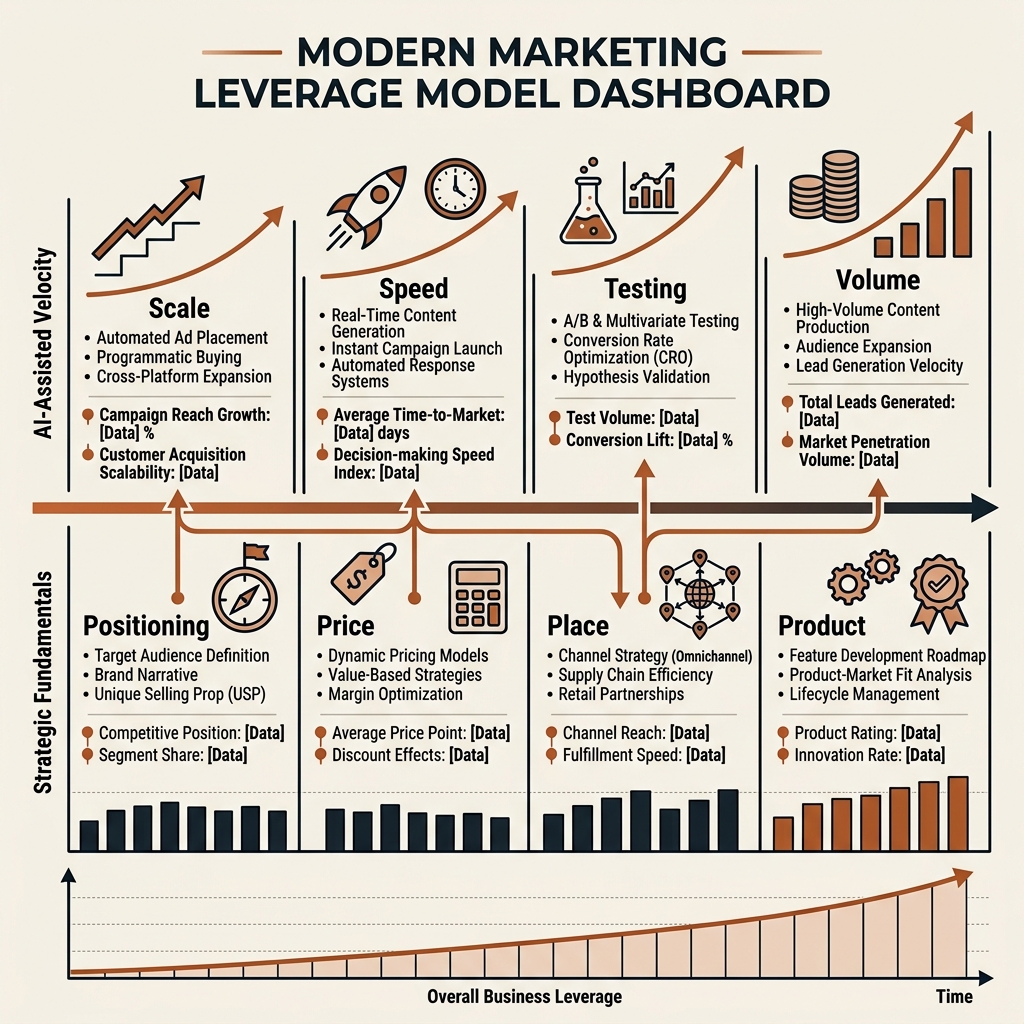
The marketing leaders winning in 2026 are not the ones who abandoned the old rules for the new tools. They are the ones who hold both ends of the spectrum simultaneously:
- Strategic Fundamentals: The deep, unglamorous work of customer interviews, pricing model analysis, positioning audits, and value proposition design. This acts as the guidance system.
- AI-Assisted Velocity: The hands-on execution of using models to generate variation, code landing pages, automate database reporting, and build campaign assets at speed. This acts as the engine.
Strategy without modern execution velocity is slow and easily outpaced. Execution velocity without strategy is noise at scale. The modern craft is the combination of the two: using AI to accelerate your execution so that you have the time and cognitive space to focus on the strategic fundamentals. The leverage is in the execution, but the margin is always in the thinking.