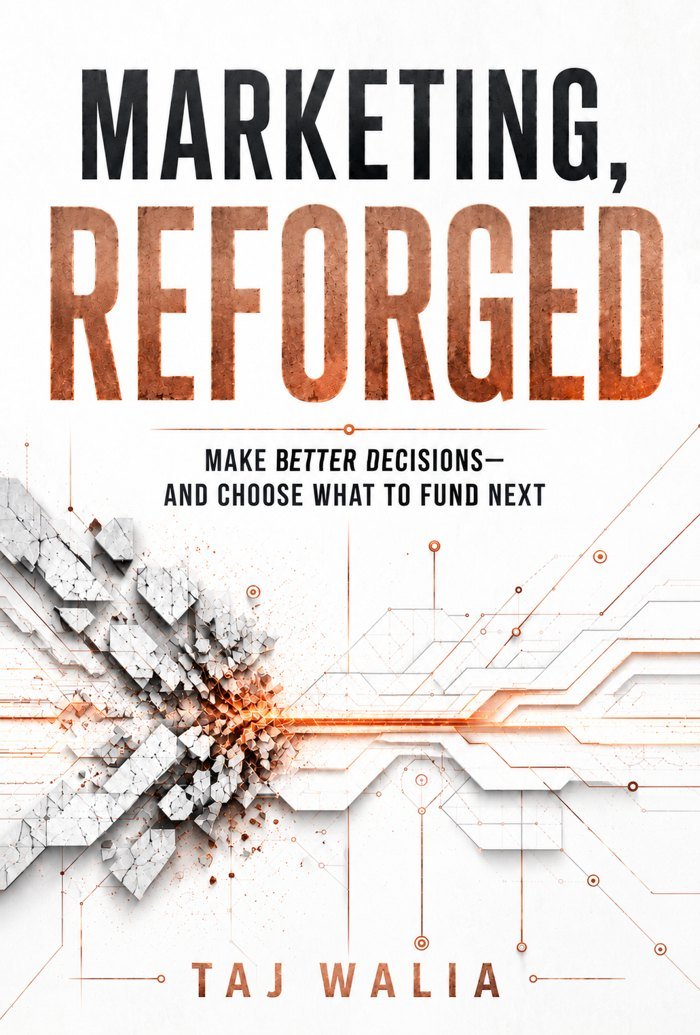
Marketing, Reforged — cover
In production · 2026

Marketing, Reforged

Make better decisions — and choose what to fund next.

Your marketing report looks better. The business still needs more of the right work. So what should you fund next?

Second book · Following The Business Command Center

The premise

Decisions die in the handoff.

Not the work. The reasoning behind it.

A decision can lose its meaning between the meeting, the brief, the sales conversation and the report.

People do competent work with the part they receive, while the business loses sight of why it approved the work in the first place. By the time the results arrive, nobody can say whether they answered the original question — so the next spending decision is made on a number that has been separated from its reason.

In Marketing, Reforged, I examine how to keep that reasoning useful as work passes between people — and how to let their experience change the next decision. Reforging is the argument in the title: examine what the business already has, preserve what still works, repair what fails, and reconsider what it inherited.
What's inside

A case you can follow, and a method you can use.

Twelve chapters, a conclusion and a working toolkit.

01

Greyhaven Kitchens

A fictional twenty-two-year-old renovation company runs through the whole book. Its marketing lead, owner, sales manager and agency confront competing priorities, limited staff time, and promising results that cannot tell the whole story.

02

The Decision Record

A short, deliberately unglamorous artefact that keeps a decision's reasoning attached to it as the work changes hands — and gives the next review something to argue with.

03

Decision Practice

Every chapter ends with an exercise that has an output specification and a worked example, so you can apply it to a decision already sitting on your desk.

04

From the field

Anonymised notes from my own career sit alongside the fiction — including the decision to replace popular truck-delivery videos with harder-to-produce equipment content that sales teams later found useful.

05

Operating conditions

The last part deals with what actually constrains the work: money, people and time — and how to weigh one investment against its strongest alternative.

How it argues

Three kinds of evidence, kept apart on purpose.

So you always know which one you are reading.

Layer one

The case

A composite story, clearly labelled as fiction, that lets a whole decision play out across the people it passes through.

Layer two

Field notes

Anonymised accounts from real portfolios — what was decided, what happened, and what it cost to find out.

Layer three

Cited work

Published research and public examples, named and sourced, where they genuinely support the argument.

The rule

No borrowed authority

A story is never presented as proof, and a citation is never stretched past what it actually shows.

Who it is for

Anyone who has to explain what deserves the next dollar.

Marketing leaders

Who need a decision to survive contact with a brief, an agency, a sales team and a report — and to still mean something at the next review.

Business owners

Who approve the spending, receive the results, and are left to work out whether one caused the other.

In production

I'll tell you the day it's out.

No list, no sequence, no drip campaign — one email from me when the book is available, and nothing else.